Public Records in Greenville County can be accessed instantly through the official public records portal at https://gcso.org/. A simple public records search returns property deeds, criminal history, and court case files, all categorized for quick public records lookup. Residents benefit from free public records for property and criminal history, while a public records request form streamlines official inquiries. The office at 4 McGee Street, Greenville, SC 29601 serves the community Monday through Friday.
Looking for how to obtain public records for marriage licenses or genealogy research? The Greenville public records database offers a digital archive that supports public records lookup for historians, journalists, and genealogists. A single public records request can retrieve marriage certificates, probate files, or a background check citation, all under clear public records disclosure guidelines. Call (864) 271-5210 during office hours for assistance and to confirm any public records fee schedule.
How to Search Public Records
Public Records search in Greenville County begins with the office that keeps the file. The Greenville County Sheriff’s Office portal at gcso.org covers criminal history, jail listings, and sheriff’s office reports, while deeds, court dockets, marriage licenses, probate cases, and birth or death certificates sit with other offices. You can also access warrant records to review official records. Sending a request to the wrong agency usually adds days. The steps below show how to obtain Public Records through the sheriff’s office portal and how to reach the right office for every other record type.
Official Search Portal: https://gcso.org/
Steps to Search
- Open https://gcso.org/ and find the records or inmate search option in the main navigation. These areas sit apart from news and community pages.
- Choose the search that matches your need. A criminal history lookup produces a person’s record history, while an inmate search lists people currently held in the county jail.
- Type the surname exactly as it appears on a government document, then add the given name. Avoid nicknames and initials unless you have no other option.
- Fill in any extra fields the form requests, such as date of birth, home address, or a known case number. Each added fact narrows the result list.
- Review returned entries one at a time. Compare the full name, birth date, and address before opening a result, since common names can produce several files.
- Open the matching entry and note the document number, case number, and date shown on the page. Those identifiers make a later request for a full copy faster.
- Use the site’s records request or contact option when you need a certified copy, a complete report, or a record the online search does not display.
- Ask the office for the current fee schedule and accepted payment methods before you order. Prices for criminal history products, copies, and certifications differ by product.
- Save a copy of the search result for your own notes. An online result helps you find a record, while a certified copy carries the seal and signature required for legal use.
- Look up deeds, court cases, marriage licenses, probate filings, and birth or death certificates through the responsible office listed in the category table below. The sheriff’s office cannot supply those files from its own records.
Greenville County SC Public Record Categories
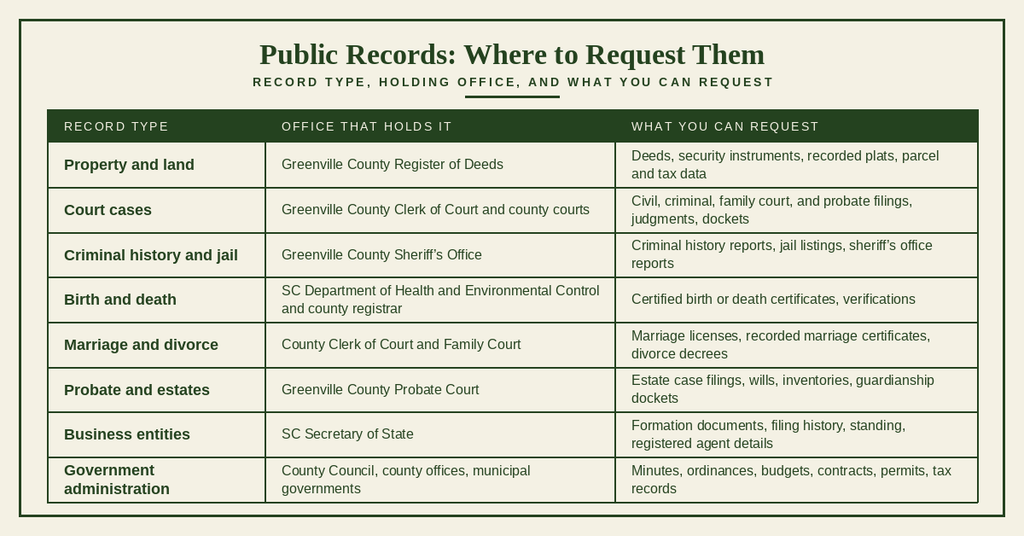
Greenville County records sit in several offices, and each office keeps a different kind of file. The table below names the record type, the agency that holds it, and what that agency can provide. Use it to confirm where a document lives before you request it.
Property and Land Records
Deeds and land records belong to the Greenville County Register of Meshes, which records deeds, security instruments, and plats in bound books. Older books carry a grantor index and a grantee index, so a researcher can trace a transfer by either name. County property and tax listings show ownership, assessed value, and parcel maps, while the recorded deed itself comes from the Register of Meshes. A sheriff’s office file will not show who owns a parcel.
For a title document, ask for the deed book and page number tied to the parcel and the recording date. A mortgage appears as a separate instrument from the deed, and lien filings sit outside county records. Some plats reach the county through state filing offices, so check the office that actually holds the original.
Court and Case Records
Greenville County court files are kept by the Clerk of Court and by the county’s civil, criminal, and family courts. Civil and traffic cases cover small claims, money claims, and traffic violations. General sessions handles felony and misdemeanor cases. Family court handles divorce, custody, and support matters, and probate court handles estates. A case number or party name leads to the docket, which lists filings, appearances, and judgments. Statewide docket searches on the South Carolina Judicial System site cover county cases filed across the state.
Ask the clerk for a certified copy when a judge, insurer, lender, or government agency needs proof of a filing or judgment. Court staff can run a file search and explain whether a case is pending or closed. They cannot advise you on the legal weight of a document, so bring specific questions to an attorney.
Criminal History and Sheriff’s Office Records
The Greenville County Sheriff’s Office provides criminal history reports and maintains the county jail roster. A criminal history report lists arrests, charges, and dispositions that the office can verify, and it is the record most employers, licensing boards, and landlords request during a background check. Requesters usually need full legal names, dates of birth, and a signed release. SLED, South Carolina’s state criminal history agency, handles checks that must include activity from other counties and other states.
Incident reports, arrest reports, and jail records follow separate request paths and carry their own fees. Files tied to an open investigation or a pending case can be withheld under state exemption rules. Juvenile matters stay closed to most requests, and a person who qualifies for expungement can have eligible records removed after the court process ends.
Birth and Death Records
Certified birth and death certificates come from the South Carolina Department of Health and Environmental Control through its certificate records system, with county registrars handling local transactions. A hospital does not issue the long-term certificate, and neither does the sheriff’s office. Order a certificate with the full name, date, and place of the event, and state whether you need a certified copy, a verification, or a long-form document. Identity rules apply because the certificate carries sensitive family details.
Older certificates may sit in state files rather than county books, and records created before statewide electronic registration can take longer to locate. Researchers often need a certificate to support a family tree, so the county registrar can point you to the office that holds a given year.
Marriage and Divorce Records
Marriage licenses in Greenville County come from the County Clerk of Court, and divorce filings move through family court. A marriage license application normally requires both parties to appear with identification, and state law sets the waiting period and how long a license stays valid. A certified marriage certificate is a separate copy produced after the license is recorded. Divorce decrees come from the family court docket, and certified copies are available through the clerk.
For family history, licenses can show the date, place, and officiant, while decrees carry property and support terms that may be sealed. Ask the clerk about current procedures for family court files that remain under seal and about the steps a party must take to request them.
Probate and Estate Records
The Greenville County Probate Court handles estate administration, wills, guardianships, and related proceedings. A filing creates a probate case number, and the docket shows petitions, inventories, accountings, orders, and distributions. Older estate work appears in minute books kept by year and page. Certified copies of a will, inventory, or order can be requested from the court for use in another matter.
Probate files often contain private family and health details, so parts of a file can be withheld even when the docket is open. The court can identify a case when you supply a name and an approximate date of death. Questions about heirs, creditor deadlines, or distributions are legal matters, so confirm deadlines with the court or an attorney instead of relying on an old file.
Business Records
Business entity filings for South Carolina companies, limited liability companies, and nonprofit organizations sit with the Secretary of State. The state’s business entity search shows formation dates, standing, registered agents, and filing history, and certified copies of formation documents can be ordered. A county business license or a local occupancy permit is a separate file held by county or municipal offices, so check those sources for a business operating in Greenville or a nearby town.
Annual reports, amendments, and registered agent changes appear in the Secretary of State filing history. The Secretary of State does not hold county tax accounts, which belong to the county assessor and treasurer.
Government and Administrative Records
County government records cover council agendas, minutes, ordinances, resolutions, budgets, contracts, procurement files, and property tax records. Greenville County Council, its boards and commissions, and the municipal governments in the county each keep their own files. Meeting materials often appear online before a vote, while closed-session material and personnel files follow different rules. A Public Records request sent to the correct records custodian starts the clock on the response deadline.
Journalists and researchers often need contracts, budgets, and grant records. Ask each office for its current retention period and for a file or contract number, since a request that identifies one document moves faster than a general request.
How Public Records Are Created
Every Public Record begins as a document created during government work and becomes official when a custodian files or records it. That sequence explains why two indexes can disagree, since one describes the document and the other describes the filing event. Knowing the sequence helps you read dates and identifiers correctly.
Government Record Creation
A deed, pleading, marriage license, birth certificate, budget, or set of council minutes becomes a record when an authorized office accepts and files it. Drafts, emails, and staff work papers stay outside the record until they are filed, adopted, or certified. Courts create records through filings and orders, the Register of Meshes through recordings, and administrative offices through adopted documents and entered minutes. Each record carries an identifier that later searches rely on, such as a deed book and page, a case number, a license number, or a certificate number.
Filing and Recording
Filing sets the official date of a document, and that date controls many deadlines. The Register of Meshes accepts deeds and plats and assigns book and page numbers. Court clerks accept pleadings and create docket entries on the day of filing, and the docket time stamp is the date used for most deadlines. Life events are registered with the state certificate system. Because records are entered in a fixed order, a document filed later can appear earlier in a printed list than one filed before it.
Record Indexing
After filing, staff index the record so people can find it without knowing the file number. Deed books carry both grantor and grantee indexes, court files are indexed by party name and case number, and certificates are indexed by name and event date. A machine-readable public records database or an API dataset can speed up bulk searches, though image-only collections still need manual review. Index entries hold short summaries rather than full text, so a record can be indexed accurately and still carry a typo in the legal description.
Record Maintenance
Agencies keep records under retention schedules that set how long each type must be held. Active files stay with the office, and closed files can move to an archive or storage area. Maintenance covers corrections, amendments, redacted copies, and replacement images for damaged pages. A file can also grow after it closes, since a later order, appeal, or claim can reopen the matter. Ask the custodian whether the copy you received includes later filings.
Record Updates
Records change in several ways. A correction deed fixes an error in an earlier instrument, a court docket updates after an appeal or new order, and an amended certificate follows a family court decision. Online systems reflect these changes on their own schedule, so a page can lag behind the paper file. A search result that looks stale may need a refreshed check with the office that keeps the source document.
Public Record Costs and Processing
South Carolina law treats looking at Public Records as free and places limits on copy charges. The sheriff’s office and other county offices set their own price lists, and those prices can change. Check the current fee schedule before ordering so you can plan for copies, mailing, and certification.
Search Fees
S.C. Code Ann. § 30-4-70 states that no fee may be charged for inspection of public records, so a search and a request to view a file carry no inspection charge. Paid products are different. A criminal history report, a fingerprint-based background check, and a bulk document set are prepared products with set prices. Third-party public records retrieval services also set their own fees, and the county office remains the source of the official document.
Copy Fees
Copy charges cover the actual cost of duplication, plus reasonable delivery and media charges when records are mailed or placed on media. Routine black-and-white pages usually cost less than oversized copies, color output, or digital delivery. A large pull can require an advance deposit, and the receipt should show what was produced. Ask what happens if a requested page turns out to be missing or exempt, so you are not charged for a document you never received.
Certification Fees
A certified copy carries the seal and signature of the office that keeps the record, and it costs more than a plain printout. Courts, title companies, insurers, passport offices, and many agencies ask for certification. Request certification when you order the copy instead of after it arrives, since the office may need to pull the original file. A plain copy can show the same facts, but it carries no proof that it came from the agency.
Request Processing Times
S.C. Code Ann. § 30-4-60 requires a public body to respond to a records request within 20 business days of receiving it. If the agency cannot produce the records in that window, it must give the specific reasons and a date for the response. Routine on-site inspection is often faster because the file is already on site, and a request for a document pulled from storage takes longer. Ask for a receipt showing the date your request arrived, since that date starts the count.
Payment Requirements
Payment rules differ by office and by product. Ask which forms of payment are accepted, whether a receipt comes with the order, and whether an advance deposit applies to a large request. Include the document, case, or license number with the payment so staff can match it to your request. Third-party services and county offices use separate payment systems, and a receipt from one does not cover the other.
Public Records Compliance Checklist
A request that names the record, identifies the agency, and arrives in the correct form is easier to answer on time. Keep a written log with the request date, the custodian’s name, the fee paid, and the delivery method. Ask each office for its current public records request form before mailing paperwork. Public records transparency improves when the public can see what was requested and when it was answered. Larger offices track these tasks with public records management software that flags due dates and stores produced files. S.C. Code Ann. § 30-4-80 allows attorney’s fees to a requester who prevails in a records suit.
Public Record Availability and Restrictions
South Carolina’s Public Records Act starts with a broad rule. Government records are open unless a listed exemption applies, and an agency must cite the specific legal basis for withholding or redacting a record. Individuals can also check incident reports to verify relevant details. Reviewing the reason early often avoids a second request and extra fees.
Records Open to the Public
Recorded deeds, court dockets, marriage license records, business filings, council minutes, ordinances, budgets, contracts, and the jail roster are examples of records agencies hold for public review. Names and positions of public employees are usually public, and many court filings appear in full unless a judge seals part of the case. Availability of a record does not mean every document in a file is open, because one file can mix public entries with exempt material.
Confidential Material
Certain categories are withheld because they carry personal or protected details. Personnel files, medical and health records, personal tax records, juvenile records, adoption records, and attorney-client communications fall into this group. Files tied to an active investigation can also be withheld during an open investigation. A withheld portion must rest on a legal exemption rather than staff preference, and the agency must explain the reason in writing when it denies a request.
Restricted Records
Some files stay out of public view until a case or process ends. Personnel investigation files, pending criminal matters, and internal working documents can carry restrictions. A request for a restricted file should ask whether the restriction has ended and what would need to change for release. An agency can hold a document even when a related court case is open, because the court file and the administrative file follow different rules.
Sealed Records
A court can seal a case or a portion of one by written order. Family court matters involving custody, protective orders, and divorce can be sealed, and juvenile and adoption files can be closed from general review. Sealing comes from a judge rather than an employee’s choice, and the order itself is often a public court document. Records that were sealed may open later, so ask about the current status and the terms of the sealing order.
Redacted Details
An agency often releases a document with exempt words and lines covered by redaction. The remaining pages still reach the requester, and the agency should state the basis for each redaction. If you need the covered material for a legal purpose, ask for the unredacted version and explain the basis for the request. A request should never be refused in full because one exemption applies to a small part of a file.
Records Exempt From Disclosure
Public records and privacy rules meet in S.C. Code Ann. § 30-4-70, which lists exempt categories rather than whole classes of ordinary government business. The list covers personnel records beyond name, position, and salary, medical and health details, personal tax records, juvenile and adoption matters, and material protected by state or federal privacy rules. A catch-all exemption must still tie to a specific legal provision. You can ask for the written reason, request the open part of the record, and consider a records suit if the denial stands.
Historical Greenville County SC Public Records
Older Greenville County documents sit in books, paper files, and public records archives rather than live databases. Many date back decades and can answer land, family, and legal questions that current online indexes cannot. Some requests require a visit, a staff pull, or a scheduled archive appointment.
Archived Records
Closed case files, old tax books, and records moved out of active offices are kept in storage or at the county archives. Staff retrieve them for inspection, and the request usually needs a year range, a book and page number, or a case name. Ask about handling rules before you visit, since many archived items can be copied but not taken from the reading area. Archival pulling takes time, so order everything you need in one request.
Older County Records
Deed books, probate minute books, court docket books, and early marriage license registers are organized by year and often by book and page. The grantor and grantee indexes in early deed books can trace a property through several owners. Probate minute books list estate cases, administrators, and heirs in a sequence that predates modern electronic dockets. Searching these volumes takes patience, and a name written by hand can differ from the spelling you expect.
Digitized Records
Many older records now have scanned images online, yet a scan is not always searchable by typing. Public records online collections vary: some carry keyword indexes for names, dates, and document types, while others list only a page image you step through by date. Coverage often runs through one year and stops, so check the date range before planning a long project. Some agencies also publish bulk data through an open data portal or an API, which supports data analysis with the same care needed for any source document.
Undigitized Records
Documents that never reached a scanning project stay on paper or microfilm. Staff retrieve them from storage, and requests often carry a copy charge plus a pull fee. Bring identification, and give the custodian precise identifiers such as a year, book and page, or a case number. Make your list before you arrive, since each separate pull takes time and a second trip may be needed for items you missed.
Historical Records for Genealogy
Family research draws on marriage licenses, probate files, deeds, and tax lists, and Greenville County holds all four for many years. Marriage records can confirm a couple and date, probate records can name heirs and list property, and deed books can place a family on land. For records held by the state rather than the county, the South Carolina Department of Archives and History in Columbia keeps older state archives, and certificates for some years come from state files. Start with the county office that created the document, then move outward when the county lacks it.
Public Record Accuracy and Updates
An index entry is a signpost, not the record itself. The filed deed, docket sheet, and certificate hold the official facts, and the search pages built from them can lag or carry mistakes. Knowing which source controls protects your research and your filings.
Record Accuracy
Accuracy starts with the filed document. Staff create indexes, and a typo can enter an index without touching the original deed or order. A certified copy pulled from the office file carries more weight than a search result copied from a screen. When a screen and a certified copy disagree, the certified copy from the custodian controls.
Outdated Information
A record shows the facts as they stood when it was filed. A person’s listed address, employer, or marital status may have changed years later, and a docket can show an old case status until the court updates it. For current facts, pair the record with a separate check, such as a fresh criminal history or a current property tax listing. For historical questions, the dated record is exactly what you want.
Data Entry Errors
Common errors include confusing letters with numbers, such as I and 1 or O and 0, swapping a first and middle name, and transposing a date. They also come from handwritten sources read by eye. Search with spelling variants, drop the middle name, and check both alphabetical and numeric indexes for deeds and court files. A name that returns nothing under one spelling may appear under a second spelling you did not think of.
Updated Records
Changes arrive through new documents. A correction deed replaces an earlier instrument, a later order changes the status shown on a docket, and an amended certificate follows a family court decision. The original entry stays in the index, and the amendment appears alongside it. Ask what changed after the date of the record you hold, and request the later filing when the later facts matter.
Correcting Erroneous Record Details
An index correction and a legal correction are different. A clerk can fix a misspelled name in an index, while changing a legal document takes a new instrument, such as a correction deed or a court order. Send the office the document number, the date, and a copy that shows the correct text. For birth and death certificates, the office holding the original file handles amendments. A public records citation should list the party name, document or case number, filing or recording date, the agency, and book and page when the series uses them, so another person can find the same file.
Finding the Correct Public Record
Most failed searches trace back to a mismatch between the record and the office. A short check of agency, record type, identifiers, dates, and place resolves most cases before you spend time on forms.
Identifying the Responsible Agency
Ask one question: which office created the document. A deed is created by the Register of Meshes, a court pleading by the clerk of court, a birth certificate by the state certificate office, and a business filing by the Secretary of State. A court that hears a case is not always the office that stores the file, and a sheriff’s office cannot supply a deed. The county directory and agency sites list offices, and a short call to the switchboard confirms the correct desk.
Selecting the Correct Record Type
Many requests fail because the name is close but the document is different. Deeds, mortgages, lien filings, and tax maps are separate series. General sessions, civil and traffic, family court, and probate each use their own dockets. A criminal history report is not an incident report, and a marriage license is not a marriage certificate. A birth certificate and a death certificate come from different event series. File names vary across offices, so confirm what the document is before you request it.
Confirming Names and Identifiers
Record the legal name as it appears on the source document, including middle names, suffixes, and former names. A maiden name, a shortened middle name, or a hyphenated surname can all break a search. Official identifiers carry more weight than names: deed book and page, instrument number, case number, docket number, license number, and certificate number. Date of birth, the address on a document, and the names of other parties narrow the list further.
Matching Dates and Locations
A file can carry three dates, and each one means something different. The date on the document, the date it was filed, and the date it was recorded in the index can fall in different months or years. Search across a wider range than you expect. Location matters too, since Greenville County, the city of Greenville, and neighboring counties keep separate files, and probate venue usually follows where the person lived.
Distinguishing Similar Records
Shared names create false matches. One person may have several filings, and a married couple can appear on the same deed. Compare the full name, date of birth, and party role against the document you expect. For property, compare the legal description and parcel number rather than the owner’s name alone. For court cases, match the case number and the court division, since the same parties can have related cases in different divisions.
Search Problems
Search failures come from a small set of causes: a spelling difference, the wrong office, a filing still in processing, or a legal restriction. Working through the causes in order beats repeating the same search with the same terms.
Record Not Found
Start with an identifier instead of a name. A case number, deed book and page, license number, or certificate number finds a record even when the spelling differs. If the identifier search comes up empty, check whether the record belongs to another office or another county. Confirm the date range and the document type, then call the office with your search details so staff can check paper files.
Too Many Search Results
A common name can return dozens of files, and each one may look right at first. Narrow by date of birth, address, county, and record type, and use exact rather than partial name searches. A document number or parcel number settles the question faster than any other filter. If a name is too broad, search an associated party, such as a spouse or business partner, with the date.
Incorrect Name or Spelling
Try the legal name, the maiden name, the full middle name, and the name with no suffix. Handwritten indexes and older cards can carry shortened or misspelled names. Search the surname first, then scan the given names by eye. A wrong first initial can push a real record out of the results, and some systems treat punctuation differently than you expect.
Wrong Agency
The most common mix-ups involve deeds, criminal cases, and family records. Deeds come from the Register of Meshes, court dockets from the clerk of court, criminal history reports from the sheriff’s office, and birth or death certificates from the state. Marriage licenses come from the county clerk, while divorce decrees come from family court. A county office can point you to the right place even when it cannot produce the document itself.
Record Not Available Online
Some records have never been digitized, and some have images without a typed index. New filings can sit in processing before they appear, and closed files may be in storage. Look for the year coverage of each online collection and check whether the site labels a record as available by request. A request for paper records may take longer and may carry a pull fee, but it remains a valid way to get the document.
Restricted Record
A missing record may be sealed, redacted, or exempt rather than absent. Ask for the written reason and the legal basis for the restriction. Some exemptions cover only part of a file, so request the open portion. If a judge sealed the matter, ask the clerk for the sealing order and its terms. S.C. Code Ann. § 30-4-80 gives a requester who prevails in a records suit the right to attorney’s fees.
Recently Created Record
A document filed yesterday may not appear in an index or online system today. Filing, imaging, indexing, and posting happen as separate steps, and backlogs shift the timing. Ask the clerk or the sheriff’s office for a file-stamped copy of the filing, which can often be produced on request. Record the date you checked and check again after the office’s posted processing time.
Contact Details
Reach the Greenville County Sheriff’s Office for criminal history reports, jail records, and sheriff’s office file requests. The office can confirm the current fee schedule, accepted payment methods, and the request format it wants.
- Address: 4 McGee Street, Greenville, SC 29601
- Phone: (864) 271-5210
- Office hours: Monday through Friday, 8:30 AM to 5:00 PM
Frequently Asked Questions
Find quick answers about accessing public records in Greenville, SC, and learn how to request the documents you need.
How can I start a public records search in Greenville?
Begin at the agency that holds the record type you need. For criminal history, jail lists, or sheriff reports, visit the Greenville County Sheriff’s Office portal at gcso.org. Property deeds, court dockets, marriage licenses, probate files, and vital records are managed by separate county offices. Identify the correct office, then use its online search tool or submit a request form. Calling (864) 271-5210 can confirm the proper location and any required identification.
Where do I file a public records request for marriage licenses?
Marriage licenses are kept by the Greenville County Register of Deeds. Submit a request using the county’s online portal or the paper request form available on the Register’s website. Include the names of the parties, date of marriage, and a valid photo ID. The office processes requests during regular business hours, Monday through Friday, 8:30 AM to 5:00 PM. Expect a response within a few business days if the request is complete.
What fees apply to free public records online in SC?
Many basic searches on the GCSO portal and other county sites are free of charge. Fees may appear for certified copies, large document batches, or expedited handling. The fee schedule is posted on each agency’s website and varies by document type. If a cost is required, the payment can be made online or in person when you pick up the record. Always verify the fee before submitting a request.
How do public records access laws affect privacy?
South Carolina law grants public access to most government records while protecting personal data such as Social Security numbers, medical information, and certain law‑enforcement details. Agencies must redact protected information before release. Exemptions are listed in the state’s public records statutes. If you believe sensitive data was disclosed, you can file an appeal with the agency’s records officer or contact the state Attorney General’s office.
Can I use the GCSO portal for background checks?
Yes, the Greenville County Sheriff’s Office portal offers searchable criminal history and arrest data useful for basic background checks. The site provides name‑based queries, booking dates, and charge details. For comprehensive checks, you may need additional records from the court system or state police. Remember that some information may be exempt or require a formal public records request.